
Home  /  Services  /  Software Development · API Integrations

API Integrations

The systems you run, talking to each other — no more copy-paste between tabs.

A business is an ecosystem of systems, and the value is in the connections: the payment that books itself, the order that routes itself, the report that assembles itself. When the connections are missing, the ecosystem runs on copy-paste and a person as the middleware. We build the integrations — the APIs, the syncs, the webhooks — that remove the human from the loop, with the monitoring to prove the data is still moving.

  • Designed around your data flow: what moves, where, how often, in what shape
  • Secure by default: scoped credentials, encrypted channels, signed webhooks
  • Failure handling that does not hide: retries, dead letters, alerts with context
  • Documented and monitored — your team can see the data moving
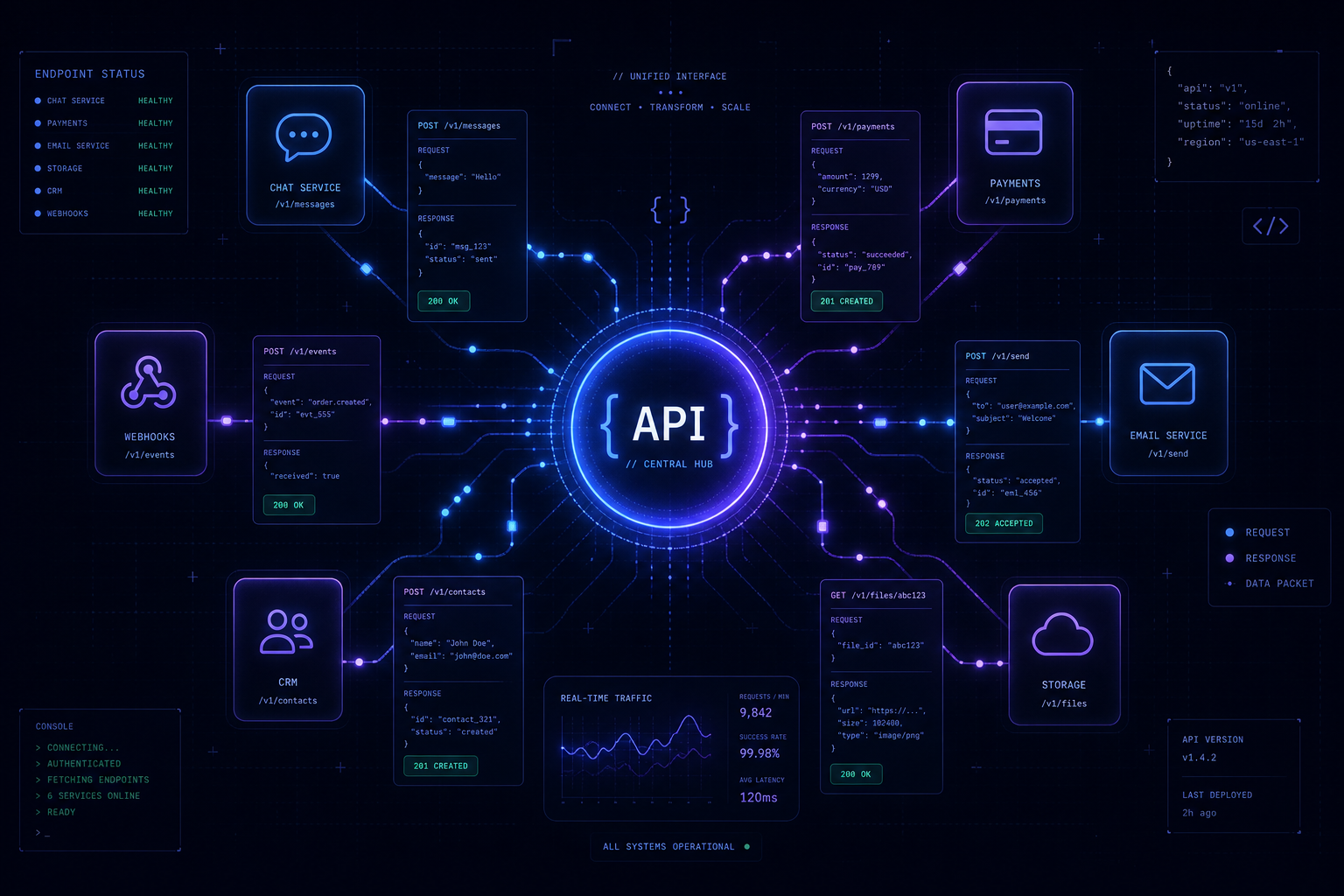
Visual representing API Integrations
Software Development Outcomes first
THE SERVICE SYSTEMAPI Integrations 20
Map Contract Build

The problem

The human is the middleware.

Somewhere in the business, a person is a system: they copy the order from the site into the back office, re-enter the payment reference into accounting, check the marketplace dashboard, update the spreadsheet, and send the confirmation. They call it “just how it works.” It is the integration, and it is the most expensive, least reliable, and first-to-be-overworked one you run.

Every manual bridge has the same failure signature: it works until it does not — a missed row, a stale number, a late confirmation — and the fix is always a person, at the worst time, apologizing.

Sound familiar?

  • Data travels between two systems by copy-paste, daily
  • A system “works fine” until the reference is entered wrong
  • You discover the sync broke a week after it did
  • The person who knows how it all connects is on holiday

What we actually do

The integration stack, in four blocks.

From a single connection to a connected business:

01

Payments & commerce

The money, without the re-entry.

  • Payment gateway integrations with reconciliation and refunds
  • Marketplace and platform order flows: one pipeline, many doors
  • Invoicing and accounting sync: the books keep themselves
  • Subscription and billing state machines done correctly
02

Core business systems

The spine connections.

  • CRM, POS, e-commerce and inventory on one data spine
  • ERP and accounting connectors with field-level mapping
  • Logistics and delivery: dispatch, tracking, the customer update
  • The internal APIs your own software stands on
03

Data & messaging

The flows that keep it alive.

  • Webhooks: signed, verified, idempotent, replayable
  • Batch syncs for the data that moves nightly, not live
  • Notification pipelines: email, SMS and push, per event
  • Master data: the customer, the product — one definition everywhere
04

Reliability & ops

The part nobody sees — until it matters.

  • Scoped credentials and least-privilege access per connector
  • Retries, circuit breakers and dead-letter queues with context
  • Reconciliation reports that prove the flow, daily
  • The integration dashboard: volumes, latencies, failures, drift

The machine

The data flow, engineered.

How a manual bridge becomes a monitored, verifiable connection.

01

Map

The data flow drawn out: what moves, in what shape, at what frequency, and what must be true on both sides.

02

Contract

The interface designed before code: the payloads, the field mapping, the error responses — agreed with both systems’ owners.

03

Build

Connectors with the hard parts done properly: authentication, idempotency, pagination, and the transformations the data needs.

04

Fail

The failure path designed as a feature: retries with backoff, the dead letter with context, and the alert that finds a human.

05

Verify

The reconciliation: what left, what arrived, what did not — a report that proves the flow, not a hope.

06

Watch

The monitoring: volumes, latencies, failures and drift, on a dashboard the team actually glances at.

An integration is only as good as its worst failure. We build the failure handling first, and the happy path becomes the easy part.

How it works

From copy-paste to automatic.

Week 1

Flow mapping

The data flow traced end to end: sources, shapes, frequencies, and the current human workarounds being retired.

Week 2

Interface design

Payloads, field mappings and error contracts agreed with the owners of both systems — the contract that keeps the build honest.

Week 3–6

Build

Connectors built with auth, idempotency and the transformation layer. Test traffic runs in your environment with real data shapes.

Week 6–7

Parallel & reconcile

The integration runs beside the manual process for a full cycle; every record is matched, and the exceptions are worked out.

Week 7–8

Cutover & monitor

The manual path retires. The monitoring goes live: volumes, latencies, failures and the daily reconciliation report.

Ongoing

Maintain & extend

APIs change — we keep the connectors current, and the map is ready for the next system to join the flow.

Scope of engagement

Every deliverable, named upfront.

  • The data flow map: what moves, in what shape, at what frequency
  • Connectors with auth, idempotency and field-level mapping
  • Failure handling: retries, dead letters, alerts with context
  • Reconciliation reports that prove the flow, daily
  • The integration dashboard: volumes, latencies, failures, drift
  • Documentation: the interfaces in writing, testable by your team
  • Maintenance: connectors kept current as the APIs move

FAQ

Integrations, straight answers.

It happens more often than vendors admit. Options in order of preference: a file or feed we consume on schedule; a database-level connector where access allows; a middleware that emulates the missing API; and, last, a UI-level bridge — the least robust, used only when nothing else exists, and monitored like the fragile thing it is. The flow mapping is where we find the cleanest door and write the trade-offs down.

Three layers. Idempotency: the same event applied twice changes nothing. Reconciliation: the daily report matches what left against what arrived, and the mismatch is a named, fixable item. Rollback: the integration can be paused without losing in-flight state. Your data is the business — the integration is built to be a guest in it, never a vandal.

The integration ships with its own dashboard: run volumes, latencies, failures, and the daily reconciliation — plus alerts on the channels your team watches. We offer maintenance for the connectors (APIs do change), but the design rule is that the monitoring is readable by your team without us: if only we understand the dashboard, the integration is still half our problem.

A single well-scoped connector is often a two-to-four-week build; a chain of systems is scoped per connection after the flow mapping. We price per integration with the flow, the failure paths and the monitoring in scope — so the “it works” and the “it works when the other side hiccups” are both covered, not a surprise later.

Which two systems should not require a person in the middle?

Name the pair — or the chain — where data currently travels by hand. We will design the integration: the flow, the failure paths, and what it replaces.

Still comparing options? Ask Alia, our growth assistant — bottom-right corner. She’ll point you to the right service or blueprint, and hand you to a human when she doesn’t know.