
Home  /  Services  /  Bpo & Business Services · Back Office & Admin Support

Back Office & Admin Support

Orders, invoices, documents and follow-through — the work behind the work, handled daily.

The business has two engines: the front office that wins the work, and the back office that makes sure the work actually happens. Orders get processed, invoices get raised, documents get filed, records get updated, follow-ups get chased — by people whose whole job is the machine. You keep the customers; we keep the machine running, with a daily handover that tells you exactly where everything stands.

  • Order processing and invoicing support, done to your process
  • Documents, records and files kept organized and findable
  • Coordination between teams, vendors and partners — chased properly
  • Daily handover notes: what moved, what is pending, what needs you
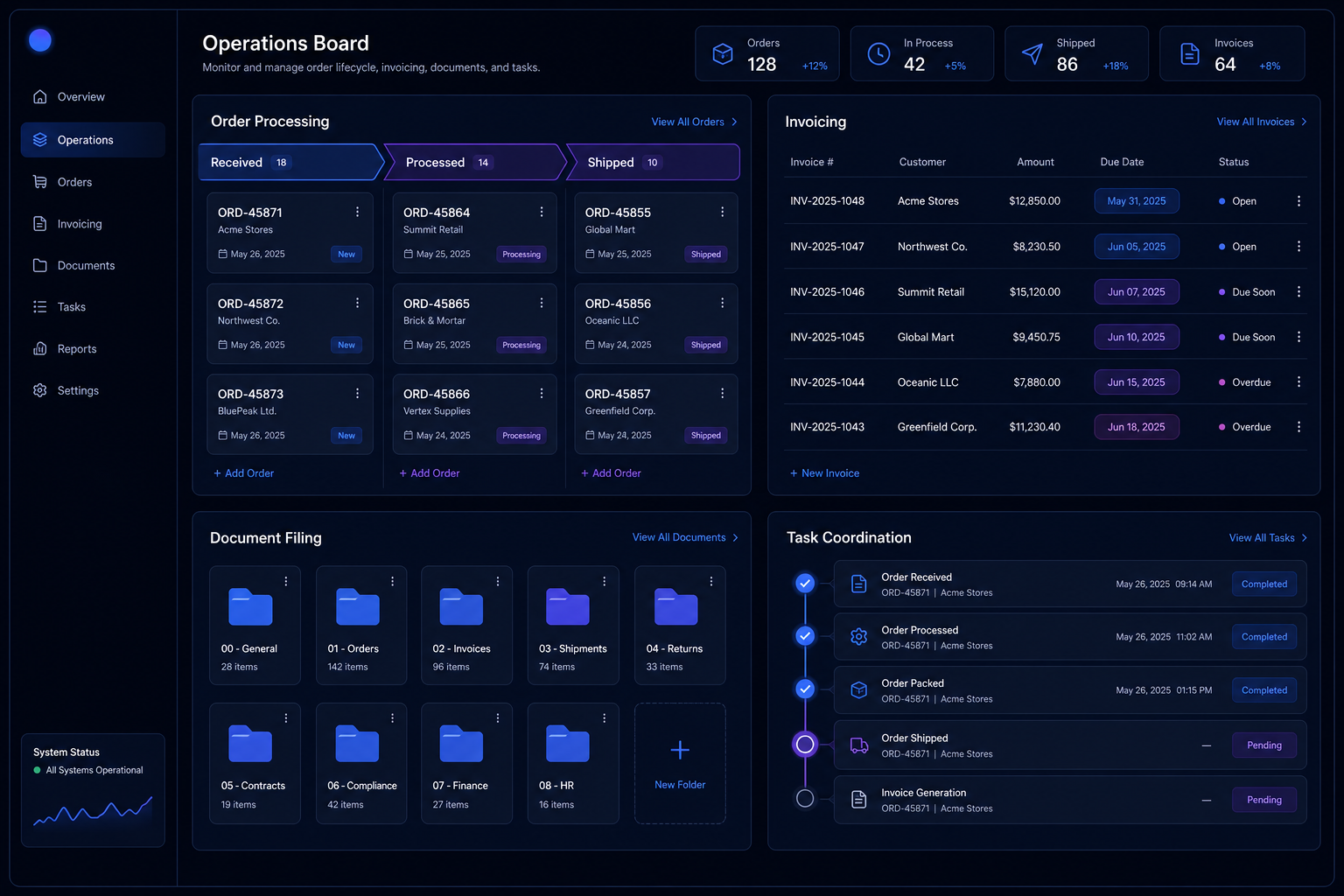
Visual representing Back Office & Admin Support
Bpo & Business Services Outcomes first
THE SERVICE SYSTEMBack Office & Admin Support 26
Receive Process Coordinate

The problem

The back office runs on whoever remembers.

Every business has an operational layer: the orders to process, the invoices to raise, the documents to file, the records to update, the vendors to chase. In a lean company, that layer has no owner — it belongs to everyone and therefore to no one. It gets done in the gaps, around the client work, and it silently defines how professional the business actually feels.

The cost is quiet but real: the invoice that goes out a week late, the order nobody confirmed, the contract nobody filed, the vendor nobody chased. Clients do not think “the back office is busy” — they think “this business is a little loose.”

Sound familiar?

  • Invoices go out when someone remembers, not when they are due
  • The same documents get re-asked for, because they were never filed
  • Vendor and team coordination lives in your head
  • The day ends with a list of “small” tasks that never finished

What we actually do

The operational layer, in four blocks.

Start where the pile is biggest:

01

Order & invoice processing

The money, moving on time.

  • Orders verified, confirmed and tracked through fulfillment
  • Invoices raised, sent and chased to the due date
  • Credit notes, adjustments and corrections handled cleanly
  • The order-to-cash trail complete and auditable
02

Documents & records

The files, finally findable.

  • A folder structure your whole team can use
  • Contracts, POs and certificates filed, versioned and findable
  • Record-keeping for clients, projects and compliance
  • Document prep: signatures, scans, exports, handovers
03

Coordination & follow-up

The chasing, done properly.

  • Vendor and partner coordination with the updates logged
  • Internal follow-ups between teams, tracked to closed
  • Client administrative communication on your tone
  • The “who owes what” list, current every day
04

Systems & hygiene

The tools, kept clean.

  • CRM, sheets and drives updated as the work happens
  • Data hygiene: the trickle kept clean, not just the project
  • Process documentation — so the work survives any person
  • Monthly reconciliation: the numbers that should match, do

The machine

The day, handled — and handed over.

The operational loop, run by people whose job is the loop.

01

Receive

The work arrives: orders, documents, requests, follow-ups — into defined inboxes and queues, not a person’s memory.

02

Process

Each item handled to the written process: verified, recorded, invoiced, filed — with the standard for “done” defined up front.

03

Coordinate

The people on the other side — vendors, teams, partners, clients — chased and kept moving, with the updates logged.

04

Record

Every action lands in the system of record: the CRM, the sheet, the drive, the accounting tool — findable later, without the archaeology.

05

Hand over

The daily note: what moved, what is pending, what is blocked, what needs your decision — so the day never ends with a mystery.

The back office is a system, not a scramble. If a task has a process, it can be handed over — and if it can be handed over, it can stop depending on you.

How it works

From the pile to the process.

Week 1

Process mapping

We walk the current operational work: the tasks, the tools, the pain points and the “definition of done” for each. The process documents are written.

Week 2

Handover setup

Access, inboxes, queues and the daily handover format are set up. The team is trained on your processes and your systems before they own them.

Week 3

Parallel run

The team runs the work alongside your current setup. Discrepancies are found, fixed and documented — the process proves itself before it carries the load.

Week 4

Cutover

The back office hands over: the queues, the routines, the daily note and the monthly reconciliation become the new normal.

Ongoing

Run & refine

Daily handovers, monthly reconciliation, and the processes updated as the business changes. The machine keeps running — and you can see it in the reports.

Scope of engagement

Every deliverable, named upfront.

  • The documented operational processes and definitions of done
  • Order and invoice processing, run to your process
  • A document and record system your team can use
  • Vendor, partner and internal coordination, logged and chased
  • CRM and accounting data kept current as the work happens
  • The daily handover note: moved, pending, blocked, needed
  • Monthly reconciliation and the process review

FAQ

Back office support, straight answers.

The operational work that makes the business run but is not itself the client work: order and invoice processing, document and record management, vendor and internal coordination, data upkeep in your CRM and accounting tools, and the daily administrative follow-through. At the mapping stage we list every task with its process, so the scope is explicit — you always know what the team owns and what you keep.

Least privilege, documented, and revoked cleanly. Each team member gets access only to the tools the scope needs — the invoicing tool, the drive folders, the CRM views — with the access list written down and reviewed at handover and at exit. Confidentiality is part of onboarding, and your sensitive documents follow your data rules, not ours.

That is usually the first deliverable. If the process lives in a person’s head, we document it — walking the current way of working, writing the steps and the definitions of done, and testing it in the parallel run. A process that is documented is a process that can be handed over, and that is the point: the work should stop depending on who happens to be around.

Against the scope: the tasks, the volume and the hours the operation needs — as a monthly service, not hourly billing. Scaling is a conversation, not a contract renegotiation: volumes rise, tasks get added, the scope document updates and the pricing follows the written scope. You are never surprised by the bill, because the bill follows the document you signed.

Where does the work pile up at the end of the day?

List the operational tasks that never quite get finished. We will map which ones we can take, the process each one needs, and what the daily handover will look like.

Still comparing options? Ask Alia, our growth assistant — bottom-right corner. She’ll point you to the right service or blueprint, and hand you to a human when she doesn’t know.