
Home  /  Services  /  Bpo & Business Services · Virtual Assistants & Executive Support

Virtual Assistants & Executive Support

A trained assistant who knows your business — screened, managed, and reporting what got done.

The most expensive hour in your business is the one you spend on email triage, booking calls and hunting for a file. A good virtual assistant hands those hours back — but only if they are screened for judgment, trained on your systems, and managed like a team member instead of a gig. That is how we run our VAs: a defined scope, a clear SLA, and a report that shows the week, not the vibes.

  • Screened for communication and judgment — not just availability
  • Trained on your tools, your tone and your way of doing things
  • A written scope, response times and a weekly completion report
  • Swap or scale the team as your workload changes
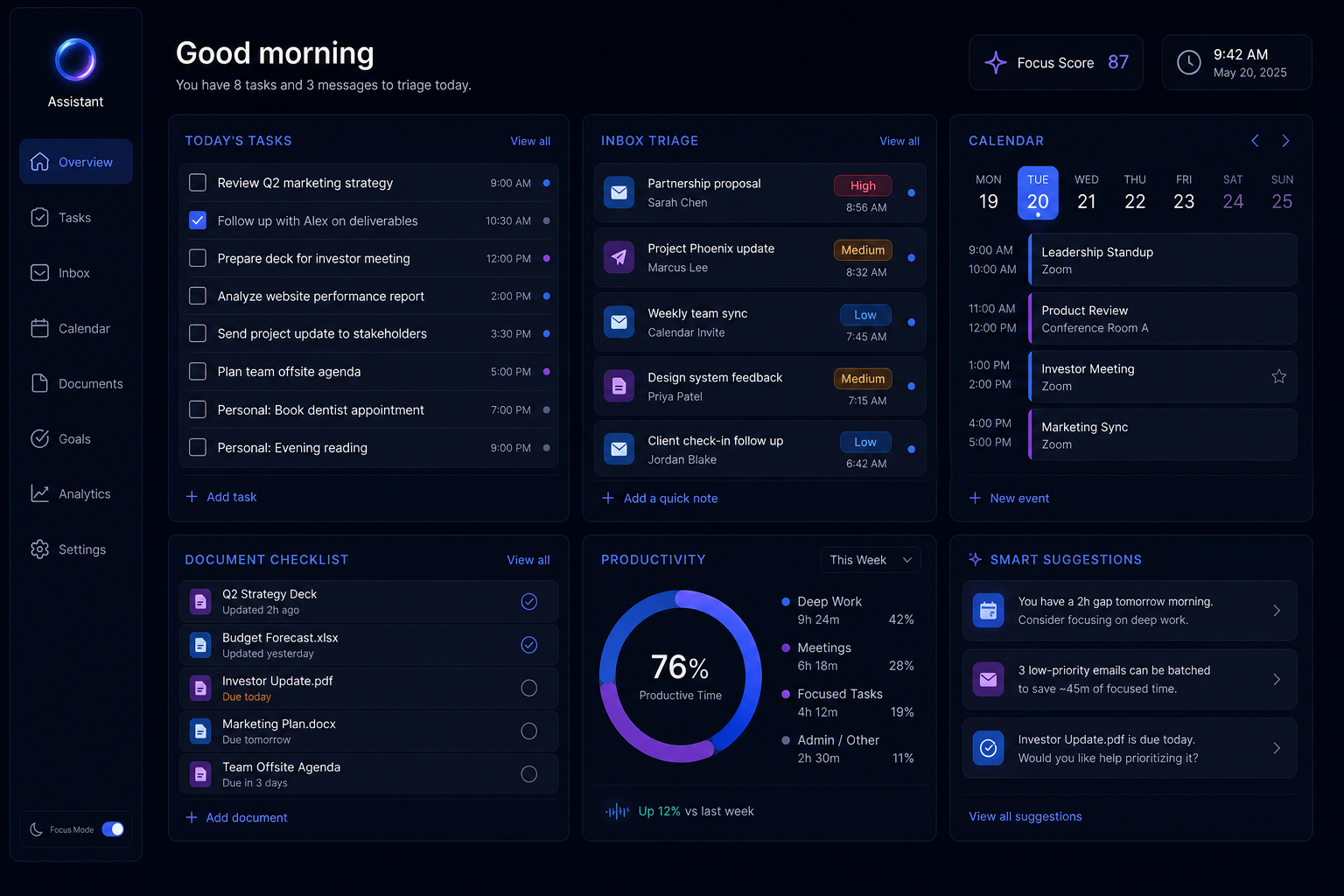
Visual representing Virtual Assistants & Executive Support
Bpo & Business Services Outcomes first
THE SERVICE SYSTEMVirtual Assistants & Executive Support 22
Scope Select Onboard

The problem

You are the bottleneck in your own business.

The founder or the senior person is where the work piles up: the inbox, the calendar, the research, the documents, the follow-ups. It is not a capacity problem — it is a focus problem. Every hour spent on admin is an hour not spent on the decisions, the sales and the product that actually move the business.

Hiring help is not the hard part; hiring help that you do not have to manage is. Most assistant arrangements fail quietly: tasks slip, context is lost, and the person ends up spending their day explaining what should have been obvious.

Sound familiar?

  • Your inbox is a to-do list wearing a badge
  • The same five tasks keep landing on your desk every week
  • The last assistant needed more managing than helping
  • Important follow-ups wait until “when you get to them”

What we actually do

The assistant scope, in four blocks.

Start with one block; expand as it earns trust:

01

Executive support

The day, managed.

  • Inbox triage with your prioritization rules, not their guess
  • Calendar management: booking, conflicts, prep notes
  • Meeting prep and follow-up actions tracked to done
  • Travel planning and the small logistics that stack up
02

Admin & documents

The records, in order.

  • Document preparation: decks, briefs, contracts for signature
  • Filing and folder discipline your team can actually find
  • Contact and CRM data kept current and clean
  • Recurring admin on a schedule, not a memory
03

Digital & research

The answers, found.

  • Market, competitor and contact research with sources
  • Content formatting, scheduling and basic social support
  • Simple data work: lists, spreadsheets, exports
  • AI-assisted workflows — used properly, checked properly
04

Management & SLA

The part that makes it work.

  • Written scope, response times and availability windows
  • Weekly reporting: completed, pending, blocked, next week
  • Quality review by a team lead, not by you
  • Swap, scale or retrain as the workload changes

The machine

From “I need help” to “it just gets done.”

The onboarding system that turns a new hire into a working assistant in days.

01

Scope

We map the tasks: frequency, tools, access, quality bar and the “definition of done” for each — in writing, before anyone starts.

02

Select

From a screened pool, you meet the shortlist. Communication, judgment and reliability are tested, not assumed.

03

Onboard

Structured onboarding: your tools, your tone, your files, your exceptions — documented so the next person can inherit it too.

04

Run

Daily task flow with response-time commitments: what is handled, what is escalated, what needs your decision.

05

Report

A weekly completion report: what got done, what is pending, what blocked — so you are managing outcomes, not chasing status.

Every VA works under a team lead who reviews quality — the difference between a freelancer and a service.

How it works

From first call to working assistant.

Day 1

Scope mapping

We list the tasks, the tools, the access and the quality bar. You get a written scope and the SLA you are buying.

Day 2–4

Shortlist & interview

A screened shortlist for your review; a working conversation with the candidates; you pick the fit.

Week 1

Onboarding

Structured onboarding: tools, tone, files, exceptions — documented from day one, with your team shadowing the first tasks.

Week 2

Ramp & correct

The assistant works the live queue under review. Friction points are fixed fast — this is where the system proves itself.

Ongoing

Run & report

Steady state: daily flow, weekly completion reports, and the scope evolves as more work moves across.

Scope of engagement

Every deliverable, named upfront.

  • A written task scope with response times and definitions of done
  • Screened, interviewed and selected assistant(s)
  • Structured onboarding with documented processes
  • Daily task flow with clear escalation rules
  • Weekly completion reporting: done, pending, blocked
  • Team-lead quality review and coverage
  • Access management: granted, logged, revoked

FAQ

Virtual assistants, straight answers.

Three things: selection, structure and accountability. Our VAs are screened for communication and judgment before you ever meet them; every scope starts as a written document with response times and a definition of done; and a team lead reviews the work, not just the hours. A freelancer sells time. We sell the outcome — the work actually getting done to your standard.

The minimum the scope needs — and it is documented per person: which tools, which folders, which accounts, which data. Access is granted with least privilege, logged, and revoked cleanly when someone changes roles or the engagement ends. Confidentiality agreements are part of onboarding, not an afterthought.

A team lead does. Your VA reports to us as much as to you: the lead handles scheduling, quality review, coverage and the awkward conversations. You get the weekly report and the escalations that need your decision — you do not get a second management job.

For standard scopes, a working assistant is typically in place within a week of the scope call. Pricing is per assistant per month against the scope — not hourly billing that pushes you to waste time. At the scope call you get the number, what it covers, and what scaling up or down looks like.

What did you do this week that you should not have been doing?

List the tasks that eat your week. We will tell you which ones we can take, how fast they start, and exactly what the handover looks like.

Still comparing options? Ask Alia, our growth assistant — bottom-right corner. She’ll point you to the right service or blueprint, and hand you to a human when she doesn’t know.