
Home  /  Services  /  Software Development · CRM Systems

CRM Systems

The customer pipeline as a system — every lead, contact and follow-up owned, tracked and never lost.

A CRM is not a contact list; it is the operating system for the relationship. It decides which lead gets called back, which follow-up actually happens, and whether “the pipeline is strong” is a sentence or a number. We build CRM systems around your sales motion — your stages, your teams, your follow-up rules — so the pipeline is owned, and the follow-through is automatic.

  • Stages and fields mapped to how you actually sell — not a template funnel
  • Every lead routed and owned: no orphan inquiries, no silent drop-offs
  • Follow-ups that happen because the system runs them, not because someone remembers
  • Pipeline reporting that prices the promise, not just counts it
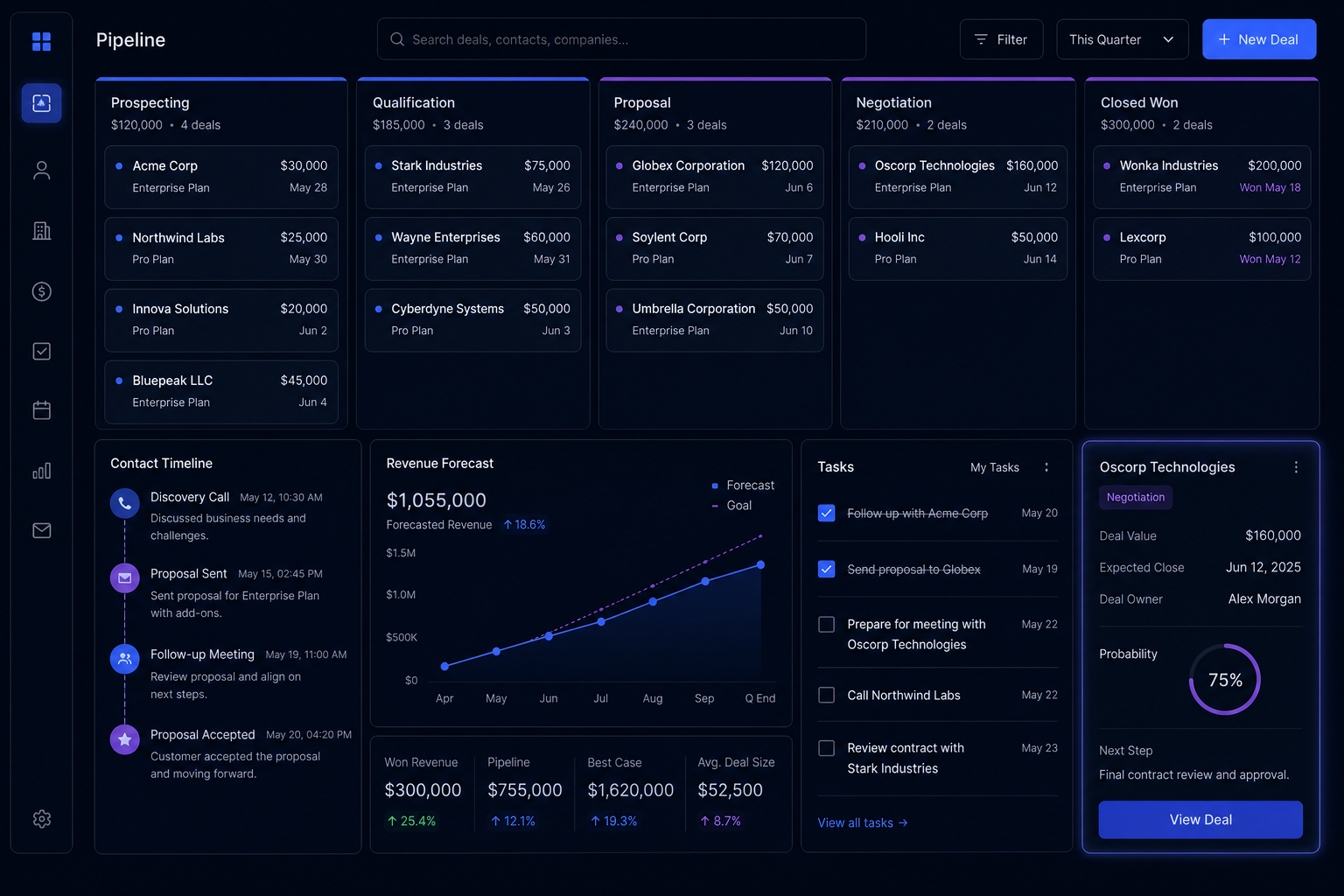
Visual representing CRM Systems
Software Development Outcomes first
THE SERVICE SYSTEMCRM Systems 18
Capture Route Work

The problem

The pipeline lives in inboxes and heads.

Follow the lead: it arrives in the inbox, or on the form, or at the counter — and from there it depends on momentum. Momentum fades. The inquiry gets answered late, the second call never happens, the quote sits untracked for a month, and the customer buys from whoever followed up. The business knows this is happening; the spreadsheet says otherwise.

The deeper cost is that nobody owns the pipeline. Without a system of record for the relationship, “how strong is the pipeline?” is a meeting, not a number — and the forecast everyone argues about is built on whoever’s memory is loudest.

Sound familiar?

  • Leads arrive fine and follow-up is the quiet failure
  • The customer history is split across an inbox, a notebook and a chat
  • When someone leaves, the relationships leave with them
  • The monthly pipeline number takes a day to assemble and still fights

What we actually do

The CRM scope, in four blocks.

From first contact to standing customer:

01

Capture & routing

No lead without a home.

  • Forms, chat, email and phone feeding one deduplicated pipeline
  • Routing rules by territory, product or workload — with fallbacks
  • Instant acknowledgment and owner assignment at capture
  • Attribution: the channel and the campaign, tracked per lead
02

Pipeline & stages

The funnel as a system, not a picture.

  • Stages mapped to your real sales motion, with entry/exit rules
  • Probability and expected value per stage — the pipeline priced, not counted
  • Stale-lead detection: the quiet stage where deals go to die
  • Quote and document workflows attached to the record
03

Activity & follow-through

The follow-up that does not depend on memory.

  • Tasks, calls and meetings on the relationship, with due dates
  • Automated follow-up sequences on your rules, with human takeover
  • Escalation when follow-ups slip — to the manager, in writing
  • Everything logged: the customer is never a stranger to the next call
04

Reporting & health

The pipeline, interrogated.

  • Pipeline value by stage, owner, product and channel — live
  • Conversion and cycle-time analytics that find the leak
  • Activity coverage: who is actually working the pipeline
  • Forecast that is a number with a trail, not a debate

The machine

The lead lifecycle, with no gaps.

Every state a lead can be in, designed, owned and measured.

01

Capture

Every channel feeds one pipeline: forms, chat, calls, counter, referrals — one record, no duplicates, no orphans.

02

Route

The lead lands with an owner by rule: territory, product, workload. Unowned is not a state the system allows.

03

Work

The stage moves the work: tasks, calls, quotes and documents attached to the relationship, visible to the team.

04

Follow

Follow-ups are generated by the system on your rules — and escalated when they do not happen.

05

Close

Won and lost are first-class outcomes: the win is booked, the loss is recorded with a reason you can learn from.

06

Keep

The relationship continues after the sale: history, renewals, referrals and the next ask — all on the record.

The CRM is built with your sales team from the first sprint — their objections are the design feedback, not the support queue.

How it works

From inboxes to an owned pipeline.

Week 1–2

Motion mapping

We map the sales motion as it runs: every channel, every handoff, every place a lead currently dies — and the stages that would describe it honestly.

Week 3–4

Design

The data model, the stage rules and the routing — approved by the people who will live in the system daily.

Week 5–9

Build

Capture, pipeline, tasks and the follow-up engine, in iterations your sales team works in weekly.

Week 9–11

Migrate & connect

Contacts and history migrated and deduplicated; the website, the ads, the POS and email connected to the pipeline.

Week 11–12

Adopt

Team training, the first month run with a coach in the system, and the dashboards switched on for the whole business.

Ongoing

Tighten

Stage rules tuned against real conversion data; sequences improved; the leaky stages fixed one by one.

Scope of engagement

Every deliverable, named upfront.

  • One pipeline fed by every channel, deduplicated and owned
  • Stages and fields mapped to your real sales motion
  • Routing and follow-up automation on your rules
  • Contact history that survives staff changes
  • Pricing and forecast reporting on the real pipeline
  • Integrations: website, ads, email, POS, accounting
  • Team adoption: training and a coached first month

FAQ

CRM, straight answers.

For many teams, a configured standard CRM is the right first move — and we configure them well. Custom builds earn their place when your sales motion is specific (multi-step, multi-channel, project-based or quote-heavy), when the CRM has to drive operations (orders, dispatch, renewals) rather than just track them, or when the data must flow into the systems you run without a human in the middle. Discovery produces the honest comparison.

You do not get them in by mandate; you get them in by making the system carry the work, not the admin. We build for the ten-minute daily reality: one screen, the open follow-ups, the stage they own. If entering the system costs more time than the old habit, adoption fails — so the capture flows (calls, notes, outcomes) are the first thing we get fast.

Profile, deduplicate, migrate, verify. We profile the current data (the inbox, the notebook, the old system), agree the deduplication rules with your team, migrate in stages, and verify against a sample you audit. The goal is a pipeline that starts clean — because a CRM that inherits your mess only makes the mess searchable.

You, completely: the database, the exports, the backups — all in your accounts. When a rep leaves, the relationship stays: every call, quote and note is on the record, not in their head. We document the data model so your team can run it without us.

Where do your leads go when nobody is looking?

Map your sales motion with us: how a lead arrives, who owns it, what happens next, and where it currently dies. We will design the CRM that closes the holes.

Still comparing options? Ask Alia, our growth assistant — bottom-right corner. She’ll point you to the right service or blueprint, and hand you to a human when she doesn’t know.